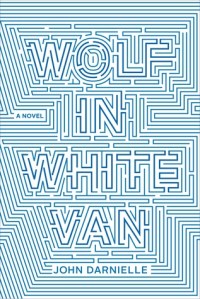
Wolf in White Van is a pretty impressive achievement, but it’s difficult to explain why that is without giving away some of what the novel does. I intentionally avoided using the word “spoilers” in that last sentence because, despite what you might think after reading the dust jacket, this is not a plot-driven book. It’s more a portrait of a single character, or a diagram of what makes him tick (though he claims at one point that nothing makes him tick). What distinguishes Wolf from other character-focused books I’ve read, however, is that Sean (the protagonist) is not someone you would normally want to see a portrait of – either literally (he has a horrible facial deformity as the result of a past traumatic event) or figuratively (he is, or at least once was, deeply weird and possibly damaged in ways you will either relate to or not; either way, reading about it is an uncomfortable experience).
One thing about the novel that was sort of a minor thing, but that I thought was clever, was how it subverted my expectations without making me feel like I’d been cheated after I realized what was happening. The dust jacket tells you, and so I will too, that Sean makes his living running a weird play-by-mail role-playing game called “Trace Italian.” In the game, players receive a scenario and choose a reaction in response to that scenario; from there, every move is is taken in reaction to a condition, and a character’s state in the next condition is a direct result of his actions in the previous one. It seemed likely to me as I read that Sean’s story was intended to sort of mirror the game, moving backward through the actions that led him to where he is now, until at the end the ultimate cause would be revealed. I was wrong about this, and to be totally honest I should have realized I was wrong long before the end of the book, for a number of reasons. Again, though this is not a book that could really be ruined by knowing what happens, I’m reluctant to just give away things the author has chosen to build up to. So I won’t. I’ll just say that if you’re the type of reader who likes books to tie things up in a bow by the end, to have everything explained and the circle completed – so am I. This book, however, doesn’t do that, and I found that more than being ok with it, I even appreciated it.
 hereisagoodbook