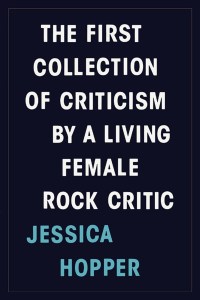
Purely by virtue of its title, which is great, I knew almost from the beginning that this book would get an entry here. The book consists of essays that the author has written for Pitchfork and other publications over the years, and while some of them are much better than others, nearly all of them are at least worth the read. Her interview with the reporter responsible for unearthing the R. Kelly sexual abuse allegations, for example, is a particularly compelling.
My taste in music is not very broad or very deep, I’m ashamed to admit. I can probably list the number of artists I really love on one hand, and the total number of artists I follow on two. Maybe, if I were really stretching to come up with names, I might have to kick off a shoe. So a book of rock criticism – I don’t listen to much real rock, Bruce Springsteen being about as close as I get – would ordinarily not be likely to catch my attention. But that title: It’s just so good.
It’s not, the author admits freely and right away, an entirely accurate title, but it’s close enough. The first essay in the book has to do with the relationship of feminism to emo music, and to popular music in general. It is, I think, the best essay in the book, and it succeeds in establishing the premise for everything that follows. Listening to music, it’s easy to forget that much of what we hear offers no voice to women, and in fact that the prevailing attitudes toward women across virtually all genres of music are, to put it simply, out of the stone age.
In the essay about R. Kelly, the reporter who dug up the sexual abuse allegations offers the following reflection on the public’s indifference to the scandal: “The saddest fact I’ve learned is nobody matters less to our society than young black women.” The same statement, applied to women generally, seems to be true of the music industry.
There are and have been, of course, successful female musicians, and several of them are written about in this book. But they seem to be the exception rather than the rule, and in many cases, the author suggests, they’ve had to ape the regressive attitudes of their male forebears to gain acceptance.
A friend of mine once told me she doesn’t like to discuss music because it’s so personal. I hadn’t thought about it, but I immediately realized she was right: A slight or a dismissive comment about your favorite song or your favorite band can feel almost like an attack on your person, in a way that similar criticisms of your favorite books or movies just don’t. And maybe that has something to do with why we haven’t demanded the same changes from the music industry that we’ve demanded from our other sources of entertainment. We like the music we like – our tastes can seem almost innate – and admitting to problems with it might feel like admitting to problems with ourselves.
Hopper is a powerful writer. She makes convincing arguments, she paints her scenes effectively, and she is frequently very funny. Most importantly, of course, she clearly knows her stuff. She made me think about music in a way that I never really have.
 hereisagoodbook