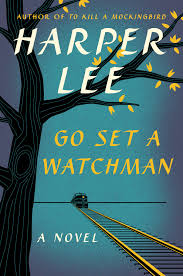
Go Set a Watchman is not a sequel. Why it is so difficult for people to understand this is completely beyond me. Part of the problem, no doubt, has to do with the way the book has been marketed. The book’s publisher has not been as forthright as I believe would be responsible about the novel’s provenance. Watchman is an early draft, a discarded draft, of a novel that was substantially revised and edited and eventually morphed into the classic we all know as To Kill a Mockingbird. Watchman was written first, then tossed aside, and never really intended for publication.
None of this is to say, however, that it’s not worth reading. All I mean is that if you try to read it as a sequel, you will be disregarding its author’s intent and also robbing yourself of any chance of enjoying the book for what it truly is – a fascinating insight into the creation of one of America’s greatest works of fiction.
Go Set a Watchman opens with an adult Jean Louise Finch returning home from New York to a small town in Alabama, where she is reunited with an old flame and her father. She has always worshipped her father as a man who can do no wrong, and so her world is shaken to its core when she discovers both her father and her beau at a meeting of a local citizens’ council – like the KKK, basically, except without the white hoods. This discovery, which comes fairly late in the novel, drives what I suppose we’ll have to call the plot, inasmuch as there is a plot: Jean Louise tries to reconcile her understanding of who her father has always been with the man she has now encountered.
Really, though, there is not much of a plot to speak of. There are a few promising threads: Jean Louise’s disconnect from her dad, the death of a white pedestrian killed by a black driver (who happens to be a close relative of Calpurnia, the Finchs’ former housekeeper), Jean Louise’s involvement with Hank. That last one, in particular, is promising at points because this book is almost as much about how much it sucks to be a woman in the 1950s as it is about race. The scenes where Jean Louise struggles with the expectations of relatives who want her to behave within the confines of her gender role are among the strongest in the book.
On its own terms, I admit, Go Set A Watchman is not a particularly good book, though it has plenty of very very good – even exceptional – moments. It contains plenty of the simple truths, plainly written, that made Harper Lee’s other novel so beloved. One of my favorites, from near the end of Watchman:
“[T]he time your friends need you is when they’re wrong, Jean Louise. They don’t need you when they’re right.”
Another one, near the beginning:
“She was almost in love with him. No, that’s impossible, she thought: either you are or your aren’t. Love’s the only thing in this world that is unequivocal. There are different kinds of love, certainly, but it’s a you-do or you-don’t proposition with them all.”
And there’s a lot more like that on the in-between pages. The book also contains many of the sorts of wry observations and humorous insights into small-town life that you find in To Kill a Mockingbird.
Even so, on its own, Go Set a Watchman couldn’t honestly be called a strong novel. But To Kill a Mockingbird was the first book I ever stayed up all night reading. The story of Atticus’ fearlessness in the face of injustice and hate and even physical danger, his refusal to give up, and his simple belief in dealing fairly and honestly with everyone he encountered have continued to inspire me throughout my life. Go Set a Watchman was worth reading, to me, for the look at the bones of the novel that has meant so much to me. It’s truly sad that so many people are so willing and able to misunderstand what this book is, and that it’s apparently causing so many people to adjust their understanding of one of the greatest ever characters in American literature.
 hereisagoodbook