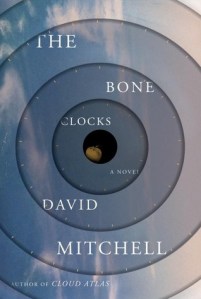
If you read the dust jacket for The Bone Clocks, you might think you had in your hands a fantasy or science fiction novel. In fact, however, 90% of the book is the story of ordinary people living ordinary lives, and that 90% is the reason that I’m writing a blog post for The Bone Clocks. David Mitchell is an extraordinarily gifted writer, one who can convincingly portray a wide variety of people, places, and times. It’s too bad that, in this effort at least, his gifts are somewhat undermined by an uncompelling fantasy plot connecting the characters and vignettes.
The Bone Clocks begins with a teenager named Holly Sykes running away from home in England in 1982. It ends with a much older Sykes saying goodbye to her grandchildren in a not-quite-post-apocalyptic 2043. In between, the novel skips across decades, continents, and narrators, but Holly is the story’s center. The other characters – a prep school kid just this side of sociopathy, a journalist covering the Iraq war, an aging novelist, and an American psychologist who is more than she seems to be – all tell their stories as they enter into and exit their orbits around Holly.
Nearly all of the characters come completely alive on the page. I love reading David Mitchell for this reason – few authors are more adept at giving their characters such believable voices. Whether it was teenage Holly, prep school Hugo, or the bitter and self-centered novelist Crispin Hershey (my favorite), each character is unique, their stories compulsively readable.
The problem, and the reason I almost didn’t write a post for this book, is the reason we’re reading their narratives at all, and that is the storyline that Mitchell has concocted. Just the thought of trying to explain it all is exhausting, but basically: There are people who can live forever by reincarnating their souls into different bodies upon death. These people are called atemporals, and the ones who organize to fight the bad guys are called horologists. Then there are other people who can live forever by killing psychically gifted mortals and draining them of their essence. These people are called Anchorites, and they don’t reincarnate; they simply don’t age and so avoid death unless their bodies are killed. Both sides are locked in a war against each other, with the horologists trying to protect the mortals from the Anchorites, and the Anchorites hoping to kill the horologists so they’ll be free to continue doing as they please. They fight by using psychic powers against each others’ souls, and they live in invisible temples and blah blah blah. Holly, who is psychically gifted, is sort-of-but-not-really a key to this battle. I don’t feel like explaining what I mean by “sort-of-but-not-really” because it will take too long.
If this sounds interesting to you, that’s great and you will probably enjoy this book. I didn’t find it particularly original or compelling. Making the whole thing more tiresome was the constant use of made-up and needlessly complex terminology Mitchell employs to describe the fantasy goings-on. For example, the Anchorites are not actually called the Anchorites – that’s just a shortened version of their group’s full name, which is:
The Anchorites of the Dusk Chapel of the Blind Cathar of the Thomasite Monastery of Sidelhorn Pass
I’m not joking. Mitchell throws around “subspeak,” “subsuggests,” “subsays,” and various other words with “sub” tacked on at the beginning whenever people are speaking telepathically, as they frequently do. Chakras are referred to, and third eyes, and verbs like “suasion” and “hiatus” and others I’m forgetting are thrown about as examples of powers that the telekinetics have over each other and others. I honestly, at various points, wondered whether Mitchell was satirizing the fantasy genre with his storyline, and to be honest I’m still not sure of the answer. If that was his intent, it didn’t quite work for me. If he wasn’t, then it also didn’t work for me.
Cloud Atlas, a book by the same author and one I absolutely loved, was also about the transmigration of souls and reincarnation, but there Mitchell told his story without feeling the need to construct some whole fate-of-the-world battle on top of it. I feel like that was a much more successful effort.
This is probably the most critical post I’ve written about a book on this blog, and I don’t want people to misunderstand: I enjoyed The Bone Clocks quite a bit. The first 400 pages, before the whole telepath plot is brought to the forefront of the action, made for a really pleasurable read. The last 50 or 60 pages, after the psycho-war is over and the novel has moved forward a few decades in time, were equally enjoyable. It’s those 100 or 150 pages in the middle that stop up the clockwork.
It’s still a good book, and if you like David Mitchell, you should definitely read it. But if you’ve never read any David Mitchell, The Bone Clocks may not be the place to start.
 hereisagoodbook
One thought on “The Bone Clocks, by David Mitchell”