
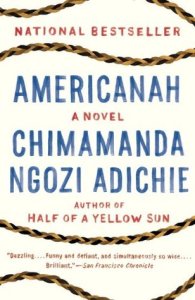
One of the really cool things about novels is how the best ones can make you feel like you’ve experienced them, rather than merely reading them. The stories can feel like something that happened to you. It is a testament to Chimamanda Ngozi Adichie’s virtuosity that she manages this feat despite the fact that the experiences she describes in Americanah are completely foreign to my own.
It would, of course, be completely naive and ridiculous for me to say that after reading Americanah I now understand what it is to be Nigerian in America, or black in America, or a black woman in America. I am none of those things, and one novel, no matter how well-written it may be, can do anything about that. But in reading this book, I had a world opened up to me that, even though it intersects and overlaps with mine in certain ways and places, I had never before seen.
The story centers on a Nigerian woman named Ifemelu who comes to the United States for college and finds herself on the one hand impressed by the positive things America offers and on the other hand disgusted by some of its failures, excesses, and forgetfulness of its own history. You might think this makes for some emotionally charged reading, or perhaps even some heavy-handed political speechifying. In fact though one of the more dominant characteristics of this book is its sense of humor. Ifemelu’s exposure to the some of the absurdities of American culture, even though those absurdities are often undeniably unjust, is usually related with a joke, an ironic comparison, or a sarcastic remark. The blurb on the cover said the book was funny, but even so I found myself smiling as I read this book far more often than I had expected to.
Which is not to say that the novel is a farce. It’s not that. It feels very real, and much of what happens in the story can be heart-wrenching. Ifemelu eventually starts a blog on the subject of race, and occasionally some of the blog posts are a little too on-the-nose for my taste. But then there are also scenes where she explains something so perfectly, and makes the reader understand so easily, that I found myself feeling stupid for being surprised by it. How could I not have known?
For me, the segment of the novel that most exemplified this last characteristic was when Ifemelu decides to use hair relaxers while trying to get a job. The book describes the burning sensation these products cause, the damage they did to her hair and scalp, and how she continued to use them anyway because she knew that if she showed up to job interviews with her natural hair, she would be turned away. The writing over these couple of pages is so powerful that you can’t help but come away with some small understanding of what this character, and so many other women, must endure.
To me, the plot was the weakest part of Americanah. Not much really happens – Ifemelu loves a boy named Obinze, but when she goes to America he is unable to follow and ends up as an illegal immigrant living in London. They maintain their long-distance relationship for a time, but events in Ifemelu’s life ultimately cause her to abruptly excise him from her life, leaving both of them with scars. Eventually, both return to Nigeria. Story-wise, that’s really pretty much all that happens. This is not a book that you read for the plot – at least, it wasn’t for me. I found myself unable to stop turning the pages, though, because the author’s description of experiences drew me in so successfully.
I know this is not my best blog post. It’s hard to think of how to explain how much I loved certain things in this book, despite the fact that I almost think it might have worked better as a series of essays than as a novel. On the other hand, the fact that it is fiction – that you feel like you are really in the world that is described – is part of what makes it so powerful. So I guess I’ll just leave it there. It’s a good book. You should read it.
 hereisagoodbook