
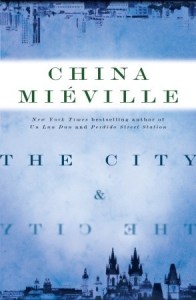
I had been meaning to read a Miéville novel for a long time. I picked up The City & The City on the strength of a really compelling staff recommendation at a bookstore in Astoria. Despite my eagerness to give the author a shot, I was a little wary: The hook of this novel seemed a little far-fetched to me, and I was worried that I would find the whole thing too meta, too would-be-literary for my taste. I needn’t have worried. Despite the fascinating originality of its setting, The City & The City is, at its core, a simple and straightforward murder mystery.
Actually, to be more specific, the book falls more neatly into the police procedural subgenre. There is no real opportunity for the reader to solve the crime on his or her own here, there is just the thrill of watching the detective at work. I’m not usually drawn to such novels, but Miéville’s strength as a storyteller, along with the previously mentioned setting (and the social details he creates to bring that setting to life) had me turning the pages late into the night.
Here is the plot: In a city in Europe called Beszel, a young woman is found murdered. The detective assigned to solve the crime doggedly pursues every lead he can find, unraveling as he goes a conspiracy with a far greater reach than he could have imagined at the beginning.
Sounds pretty ordinary, right? But here’s where the magic comes in – Beszel is more city-state than city, and it borders another similar city-state called Ul Qoma. Actually, Beszel and Ul Qoma share borders so closely that often one part of a city street might be in Beszel, while the other is in Ul Qoma. These areas of the city, called crosshatches, are everywhere. For ease of visualization, I thought of it as one city that had been split into two like puzzle pieces, and though the pieces are still technically connected, they are also separate.
And for reasons that are neither fully explained nor, apparently, fully understood by the people who live there, the people of Beszel never acknowledge the people of Ul Qoma, and vice versa. So although you might walk down the street next to an Ul Qoman, if you’re in Beszel you will never acknowledge that person, or his environs, or anything beyond the borders of your own city. You assiduously ignore their buildings, the cars that drive down their parts of the streets and neighborhoods. This is called “unseeing,” and it’s a skill all residents of both cities must develop. You certainly never step onto the other side of the street, wandering into the neighboring city. To do so is to breach, and there is a special super-governmental branch called Breach whose job it is to “disappear” those who breach into or from either city. Even the slightest acknowledgment of someone or something on the other side of a border is considered a breach (though, as you might expect, minor or accidental infractions of the rules are usually ignored).
This is a pretty weird idea, but Miéville elevates it above the status of “weird idea” by creating in a relatively short book a fully believable culture around these cities and their rules. In each city, there are extremists – groups who want to unify the two cities, or groups who want to see their city alone dominate. Customs, dress, and language differ and are memorably drawn.
Needless to say, the murder mystery spans both cities, and our protagonist uncovers a tangled web of ultranationalists, unificationists, corrupt politicians and businessmen who all may have had a reason to want the woman dead. As he investigates, we start to suspect that there may be even more to the setting than meets the eye – and that’s as much as I’ll say about the plot for fear of spoiling it.
One thing that I really liked about this novel was that although the setting made it seem like the novel was likely to grow increasingly stranger and more fantastical, that is not at all what happened. Instead, the author used the unusual setting to tell a traditional detective story, and the result is that the reader gets to fully enjoy the novel’s unique characteristics without having to increasingly suspend disbelief as events unfold. That’s important, I think, because who wants to read a murder mystery that isn’t at least somewhat believable?
Miéville’s writing is solid throughout. His sentences are spare; you won’t find a lot of flowery prose or rambling stream of consciousness pontificating here. The prose is very clearly secondary to the plot, it’s workmanlike and there aren’t a whole lot of memorable sentences, but that’s ok. You come to The City & The City for the same reason you might visit any other city – to take in the sights; to be enveloped, for a time, in unfamiliar surroundings. Getting to ride along as a cop solves an intriguing murder mystery is, almost, just a bonus.
 hereisagoodbook