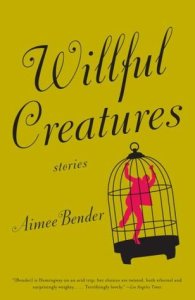
One of the great things about short story collections is that if you come across a story you don’t care for, there’s always the consolation of being just a few pages away from a fresh start. I thought about that a couple of times – not a lot, just maybe two or three – while reading Aimee Bender’s (mostly) delightfully weird Willful Creatures.
There are fifteen short stories in this collection, and in my opinion three are truly great, three fall pretty flat, and the other nine are somewhere in between. What all of them have in common, however, is their essential weirdness. Nowhere in any of this book’s 208 pages will you find a single story that you might read in any other place than in this book’s 208 pages.
The one story that comes closest to being normal is also my favorite of the bunch. In “Fruit and Words,” the main character stops at a roadside fruit stand where the proprietor also sells strange pieces of art. This is a fascinating, humorous, and also somewhat dark tale that hit me just right. Bender writes with a wonderful economy of words; her sentences are lean and precise and still manage to convey a sense of the fantastic. Those strengths are on full display throughout this collection, but they’re put to their best use in “Fruit and Words,” and perhaps it is because this is the most ordinary story. Sometimes the best way to be sure people see your strengths is by understating them.
I also enjoyed “Ironhead,” which is not at all normal: It’s about a married couple with pumpkins for heads who give birth to a child with an iron for a head. The kid grows up miserable and, spoiler alert, dies in the end. Despite its inherent ridiculousness, this is a dark and unpleasant story, and again Bender’s refusal to use more words than are strictly necessary gives it more power than such an apparently silly idea might have in the hands of a lesser writer.
Perhaps it’s because I’m a mystery fan, but the third in my top three stories is “The Case of the Salt and Pepper Shaker,” about a detective, bored at the idea of trying to solve a homicide, who instead becomes fixated on a seemingly trivial detail of the dead couple’s lives together.
A couple of the stories in this collection really didn’t do anything for me. One in particular, about babies that are formed from potatoes and follow a woman around, made me a little nauseous, if I’m being honest. But I think when you’re writing out on the ends of the branches of fiction, as Aimee Bender is here, the price you pay is that occasionally something is going to get dropped. If you have any interest at all in short stories, it’s hard to imagine that you won’t find something to like in Willful Creatures, and you also have the added bonus of the fact that you’re not going to see these stories, or anything like them, anywhere else.
 hereisagoodbook