
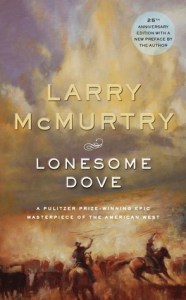
Everyone can stop looking for the Great American Novel, because Larry McMurtry published it in 1986 and it’s called Lonesome Dove.
I hate being asked to name my favorite book. It’s an impossible choice. There are so many books that I have read and loved, so many that in one way or another deserve the title of favorite. Usually I respond to the question by breaking it into a series of smaller questions: My favorite non-fiction book (probably Angela’s Ashes), my favorite 20th-century-pre-1950 American novel (The Great Gatsby), post-1950-but-pre-1970 (not sure – maybe either To Kill a Mockingbird or Catch 22?), my favorite novel of the late 20th century (too many possible options to list).
Today, for the first time in as long as I can remember, the question doesn’t seem so complicated. Maybe it’s just that I’m still lingering in the afterglow of 858 incredible pages, but right now I feel like I can say without any hesitation: Lonesome Dove is my favorite book. Bar none. Ever.
The book is a Western, but it transcends the boundaries of genre in a way no other novel I’ve read has ever managed. Whether or not you have any interest in Westerns, you should read this book. Because, more important than the fact of its genre, Lonesome Dove is a book that is absolutely stuffed with fully believable, sympathetic characters who leap off the page and into your memory as if they are real people who you have met and conversed and formed friendships with. When a character dies, you feel real pain, you genuinely mourn, because you have been on a journey with that character and you have come to love him or her, even if you didn’t agree with all the choices he made.
The subject of the book is, in fact, a literal journey — a cattle drive from the titular south Texas town all the way to Montana. Along the way, the characters run into old loves, outlaws, Indians, and more, and while many of the tropes of the classic Western can be found in this novel, McMurtry writes them so originally that you never get the “been-there-done-that” feeling that you can often get when reading genre novels.
Furthermore, although the tropes are there, McMurtry often subverts them in such a way that Lonesome Dove feels in many respects like an authorial rejection of the Western as the genre is usually done. Westerns, for example, often have tragic heroes, and so too does Lonesome Dove — except that, as you come to realize over the course of the novel and as the book’s ending makes heartbreakingly clear, these men aren’t heroes at all. They’re just deeply, deeply flawed ordinary people. Perhaps, in fact, they’re even more flawed than most ordinary people. Yes, they live their lives according to a code, but they apply that code so rigidly and so all-encompassingly that they are not able to grow as people or even, perhaps, really make any decisions at all for themselves.
I haven’t stopped thinking about the last few sentences of Lonesome Dove since I put the book down. I can’t remember the last time I chewed over a book’s ending in the way that I have for Lonesome Dove. What does it mean? Why did McMurtry choose to end his novel in that way, with those words? There’s so much going on in this novel, so much leading up to that ending, that I feel an honest desire – seriously to start the book over again from page one. If I weren’t trying to finish my next book (Jonathan Safran Foer’s Here I Am) before seeing its author speak at an event next month, I would probably do it. As it is, I definitely expect to read this book again and I hope to do so in the near future.
In short: I love Lonesome Dove. No matter who you are, you should read it. I bet you’ll love it too.
 hereisagoodbook