The Rats, by James Herbert

rats

The Rats is the literary equivalent of a 1970s horror B-movie. It’s gruesome, it’s disgusting, it’s shallow, and if you are into that sort of thing, it’s a lot of fun.

The story, which takes place in London, finds a young English schoolteacher combatting a plague of unusually large, unusually aggressive black rats that are overrunning the poorer parts of London. The rats have developed a taste for human flesh, apparently, and realize that they have the advantage of numbers over their human prey. Carnage ensues.
Continue reading

Slade House, by David Mitchell

sladehouse
Slade House is a sort of haunted house story that takes place in the same universe as David Mitchell’s 2014 novel, The Bone Clocks. I don’t know if Slade House is a better book than The Bone Clocks, whatever that means. I do think it is much more effective at drawing the reader in and getting him or her to accept some of the fantasy concepts that, for me, weakened Mitchell’s previous novel.
Continue reading

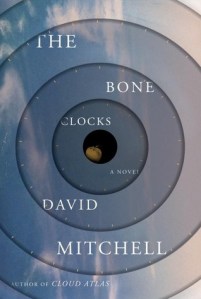
The Bone Clocks, by David Mitchell

boneclocks

If you read the dust jacket for The Bone Clocks, you might think you had in your hands a fantasy or science fiction novel. In fact, however, 90% of the book is the story of ordinary people living ordinary lives, and that 90% is the reason that I’m writing a blog post for The Bone Clocks. David Mitchell is an extraordinarily gifted writer, one who can convincingly portray a wide variety of people, places, and times. It’s too bad that, in this effort at least, his gifts are somewhat undermined by an uncompelling fantasy plot connecting the characters and vignettes. Continue reading

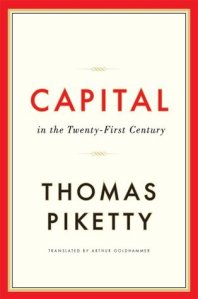
Sort of Liveblogging Capital In the Twenty-First Century, by Thomas Piketty

capital

Thomas Piketty’s Capital in the Twenty-First Century is the type of book that a certain set of people read just to be able to say that they’ve read it. Citing it in casual conversation is, in such circles, a source of instant intellectual credibility, like toting around an Ivy League degree. For these people, it’s not about what’s in the book; it’s about what having the book says about what’s in them.

Continue reading

The Quantum Thief, by Hannu Rajaniemi

quantumthief

In The Quantum Thief, a man named Jean le Flambeur escapes a prison in which his captors force him to reenact versions of the prisoner’s dilemma every day, killing him and resurrecting him over and over again in hopes of gradually rewiring his brain. He escapes the prison early in the novel with the assistance of a mysterious woman named Mieli and her spacecraft, which itself is a sentient being, apparently female, and apparently in some kind of romantic relationship with Mieli. The two of them go to Mars, where in a constantly-moving city obsessed whose people are obsessed with privacy, a young art student/amateur detective is investigating the murder of a well-known chocolatier.

Continue reading

All the Old Knives, by Olen Steinhauer

oldknives

I’ve read my fair share of spy fiction – it’s an interesting genre. What’s most surprising about it, I find, is that there is so much variation in what would seem to be a relatively narrow spectrum of possible storylines. On the one hand you have James Bond and Jason Bourne, those made-for-Hollywood action stories in which things are constantly exploding, the protagonist ever propelled toward a climax after which we know all along he will be the last one standing.

Those sorts of stories can be fun, and I’m not at all one to look down my nose at them. I still remember the pleasure and exhilaration I felt while reading Robert Ludlum’s The Matarese Circle many years ago. As much fun as they can be, though, these sorts of spy novels are popcorn literature. You consume them voraciously while they’re in front of you, but there’s not a lot of nutrition to them.

Continue reading

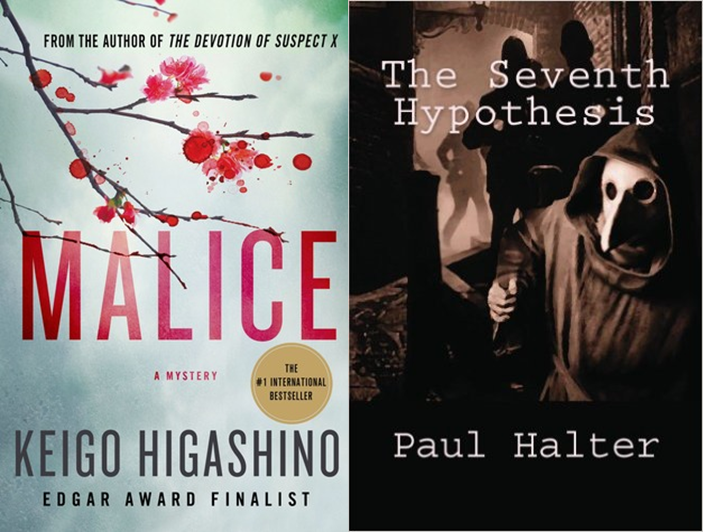
A couple of mysteries

mysteries

After reading a series of books that weren’t quite good enough to make the cut on this blog, I’m finally back with an update – and it’s not one, but two novels this time. They’re both mysteries, as I’ve been on a bit of a kick lately. I like mysteries, but I only like them when they’re fair – that is, when the reader has the opportunity to solve the crime along with the protagonist. That means, in my mind, that all the clues must be available for the reader to examine, with no last-minute revelations that the detective has all along had in his possession some crucial and hitherto unknown piece of the puzzle.

Continue reading

Between the World and Me, by Ta-Nehisi Coates

betweentheworld

A few years ago, I read a book about string theory called The Elegant Universe. When I finished that book, I felt like someone who, having just woken up, has rubbed the last bit of sleep out of his eyes and can see his surroundings more clearly. There were entire planes of existence that I could not comprehend, that book had told me, elements to the world around me about which prior to reading Brian Greene’s book I had not even the slightest inkling.

Reading Between the World and Me was in many ways a similar experience, except that instead of leaving me with a sense of exhilaration and wonder it left me with a pervading feeling of sadness and shame. Like rubbing the sleep away just to get a clear-eyed view of the disgusting mess you passed out in, the detritus of whatever regrettable things you did the night before, and feeling the familiar first pangs of what is sure to be a terrible hangover.

Continue reading

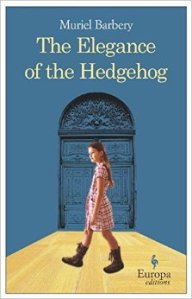
The Elegance of the Hedgehog, by Muriel Barbery

elegancehedgehog

What is it that makes us want to underline or highlight passages from books?

Frankly, I’ve always found this inclination to be something of a mystery. Until a few days ago, the only highlighting I’d ever done had been in textbooks. To mark up the text of a novel always seemed, to me, a little gauche. The more I loved a novel, the more inappropriate the idea of desecrating its pages with my own markings seemed to me. Like drawing stick figures on a famous painting, or scribbling my own thoughts into the holy texts of someone else’s religion.

Continue reading

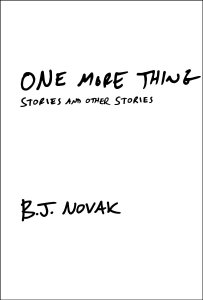
(Not really about) One More Thing, by B.J. Novak

onemorething

Short stories do not get enough attention, either by themselves or in the collections that you every now and then notice on bookstore shelves. I personally tend to ignore short story collections not authored by Stephen King (he’s at his best in the shorter format, imo), and I have no idea why. I only picked up B.J. Novak’s One More Thing on a whim – I needed something to read while waiting for my fiancee at a coffee shop in Brooklyn, and I figured it would better to read a short story or two than to start a new novel, considering that I was already reading a novel at home.

Unnecessary story interrupted, I’m very glad I bought the book. I admit that beyond my skepticism of short story collections, I was also sort of hesitant to purchase the collection because of the identity of its author – B.J. Novak is a talented television actor and I know he’s done some stuff behind the camera as well, but would those skills translate to writing short stories? I had my doubts, and worried a little that One More Time would just be a case of a celebrity cashing in on his fame for a quick paycheck. My fears were totally without basis. The short stories in this collection are by and large excellent, and generally very funny.

Continue reading